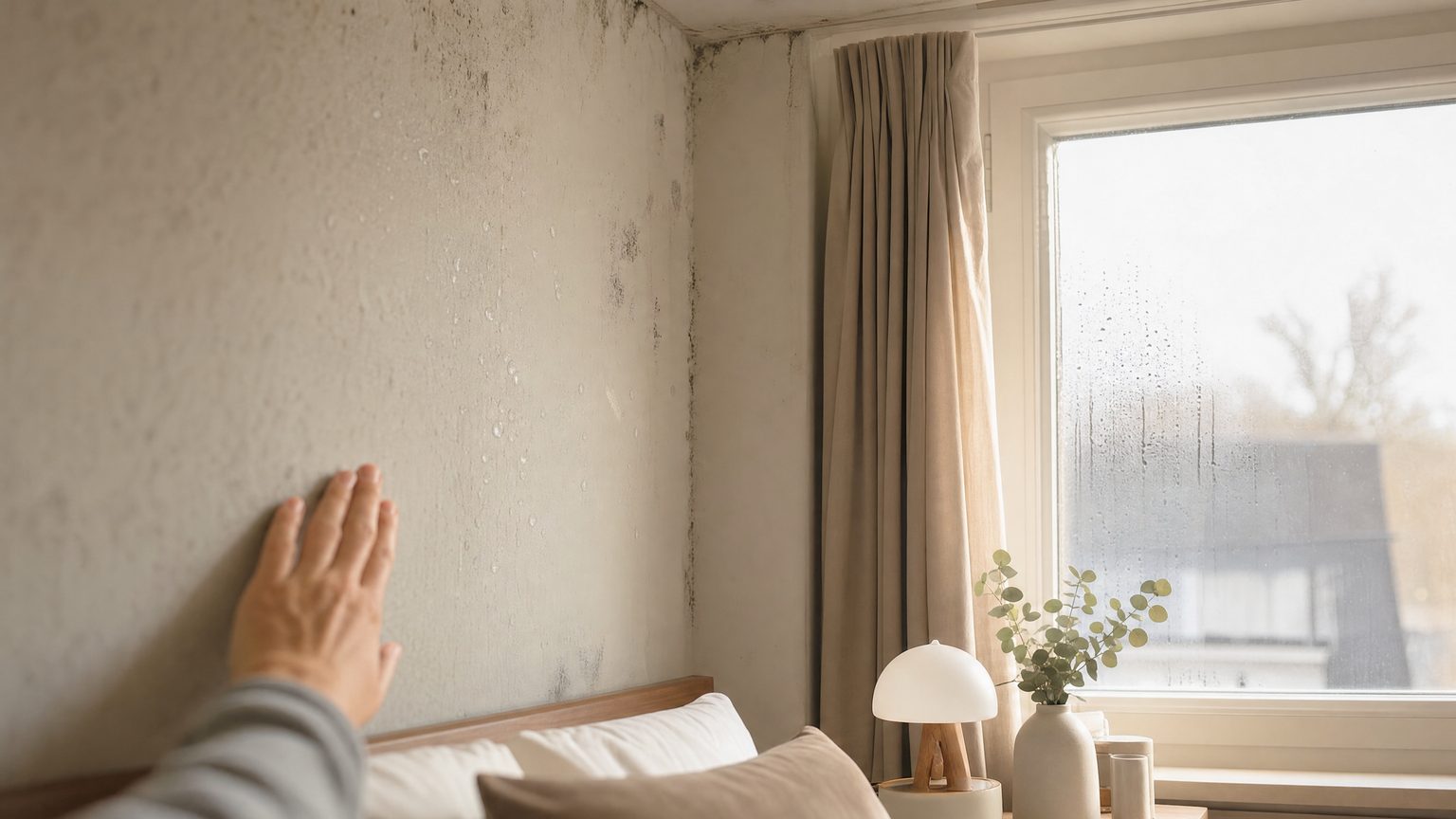
The black spots appearing in the corner of the north-facing room, the musty smell behind the wardrobe, the water droplets collecting at the window edges in winter… this is a shared complaint in millions of homes. The first suspect that comes to mind is usually a "leak" or "rain seeping in from outside"; yet in the vast majority of cases, not a single drop of water enters from outside. The real source is inside the home: the water vapour released into the air from the bathroom, the kitchen, even our own breath, condensing on cold surfaces.
And mold is not merely a cosmetic problem. Mold spores are among the known triggers of allergic reactions, respiratory illnesses and asthma complaints. Mold in bedrooms — where people spend long hours, especially children and the elderly — is a direct health concern.
In this article we cover the real physics of mold, the technical reason behind "we had insulation done but the mold didn't go away" cases, and the path to a permanent solution.
The Physics of Mold: Why Does an Iced Glass Sweat?
In summer, the outer surface of a bottle taken from the fridge sweats within seconds. No water reaches the bottle from outside; the invisible water vapour in the air turns to liquid the moment it touches the cold surface. This temperature is called the dew point (condensation point).
Your home's walls obey the same law of physics. A family's daily life (showering, cooking, drying laundry, breathing) adds litres of water vapour to the indoor air every day. When this vapour-laden air meets the cold inner surface of an uninsulated or wrongly insulated wall, it condenses just like on the iced glass. The surface gets damp — and an ideal breeding ground for mold is set up.
Two basic rules follow from this:
- Mold loves moisture, and moisture loves cold surfaces. It is no coincidence that mold appears most on north walls, at exterior wall corners and behind furniture (the spots where air can't circulate and the surface stays coldest).
- The permanent solution is not to wipe away the moisture, but to stop the surface from getting cold. Mold spray, painting over it and dehumidifier devices fight the symptom — as long as the cause remains at the wall's cold surface, the mold comes back.
How Is Moisture Removed? The Indispensable Role of Ventilation
A common belief is that walls "breathe" and expel a home's moisture to the outside. Building physics is clear here: in evacuating the moisture produced in a home, the share of vapour passing through the wall is very small; the overwhelming majority of moisture is removed through ventilation. So the formula for a healthy interior lies not in the wall's structure but in the pairing of two things: regular ventilation + the right insulation that allows no condensation. In fact, vapour-open fibrous insulation materials carry the risk of taking moisture into themselves and losing their insulation value over time — a subject covered in detail in our article "How to Choose the Right Material for Exterior Wall Insulation".
"We Had Insulation Done, but There Is Still Mold in the Corners"
This is one of the sentences we hear most often in the field. The building has been insulated, the bills have dropped somewhat — but the mold in the corners has come back. How?
The answer is usually hidden in two technical details:
1. Thermal bridges: At points where the insulation thins or is interrupted — column-beam junctions, window edges, under window sills and balcony projections — the inner surface temperature stays low. Even if the wall as a whole warms up, these points remain cold enough for condensation.
2. The separation interface: Rigid insulation boards are fixed to the wall with mortar dabs and dowels; micro-gaps and air pockets remain between the board and the wall. Vapour moving from the interior can reach its dew point at this cooler interface. The condensed water collects in that gap, the wall gets damp from within, and mold reappears at the surface through the weakest point. This mechanism is examined under the heading "the invisible gap between wall and board" in our article "How to Choose the Right Material for Exterior Wall Insulation".
In short, insulation done with the wrong material and wrong detailing does not solve the mold problem; it often merely hides it from view for a while — and the problem resurfaces in the first winter.
The Permanent Solution: Leave No Gap for Condensation to Settle
The technical formula for ending mold for good has three steps: raise the inner surface temperature above the dew point, leave no gap between insulation and wall where condensation could settle, and use a material that is unaffected by moisture.
The industry's new-generation answer that meets all three conditions together is a composite insulation layer that works integrated with concrete and plaster. The patented composite structure of polyester fiber and closed-cell polymer foam works on a different principle from classic rigid boards:
- Creates no condensation gap: It physically integrates with concrete and plaster; no interface remains between wall and insulation where water could collect.
- Applied without thermal bridges: Rigid boards have to be cut and fragmented at column-beam junctions, window edges and corner details; every joint is a potential weak point. The thin, flexible composite layer follows these details and is applied continuously — leaving no cold point for condensation to cling to.
- Raises the inner surface temperature: The wall's inner surface stays above the dew point; vapour finds no cold surface on which to condense.
- Unaffected by moisture: Thanks to its high vapour-diffusion resistance (μ=584) it holds no moisture within, and keeps its insulation value for years.
- Can also be applied indoors: Where the façade can't be touched (apartments where owners' approval can't be obtained, mold in a single room), it offers an apartment-by-apartment, room-by-room solution.
Meanwhile: 5 Practical Habits That Reduce Moisture at Home
The right insulation is the permanent solution; but these habits seriously reduce the moisture load in any home:
- Twice a day, do a 5–10 minute burst of cross-ventilation with opposite windows (instead of leaving a window permanently ajar).
- In the bathroom and kitchen, keep the extractor fan running for a few minutes after the steam has stopped.
- Place furniture at least 5 cm away from exterior walls; let air circulate at the surface.
- If possible, don't dry laundry indoors; if you do, ventilate that room extra.
- Keep pot lids on while cooking — simple but effective.
These habits reduce the moisture load; but if the wall surface keeps staying cold, they can't end condensation on their own. If the mold in the corners returns every winter, the problem is not in the habits but in the wall.
Is There a Condensation Risk in Your Home? 5 Signs
- On winter mornings, water droplets collect on the inner surface of the window panes.
- Mold always appears in the same areas: north walls, exterior wall corners, behind furniture.
- Stains painted over come back within a season or two.
- A musty smell forms inside cupboards and in textiles.
- The wall surface is noticeably cold to the touch in winter.
If two or more of these signs are present in your home, the problem is most likely condensation — and it is solved with insulation, not paint. Remember: a poorly insulated wall (one whose U-value exceeds the limit) is a wall whose inner surface stays cold; and a cold surface means it is open to condensation. For a lasting result, the insulation must be done with the right material — one that is unaffected by moisture and works integrated with the wall. And the first step is to know your wall's current condition.
Still planning your project?
The right insulation depends on your climate, your building and your budget. Our technical team can help you get it right from day one — before a single panel goes up.