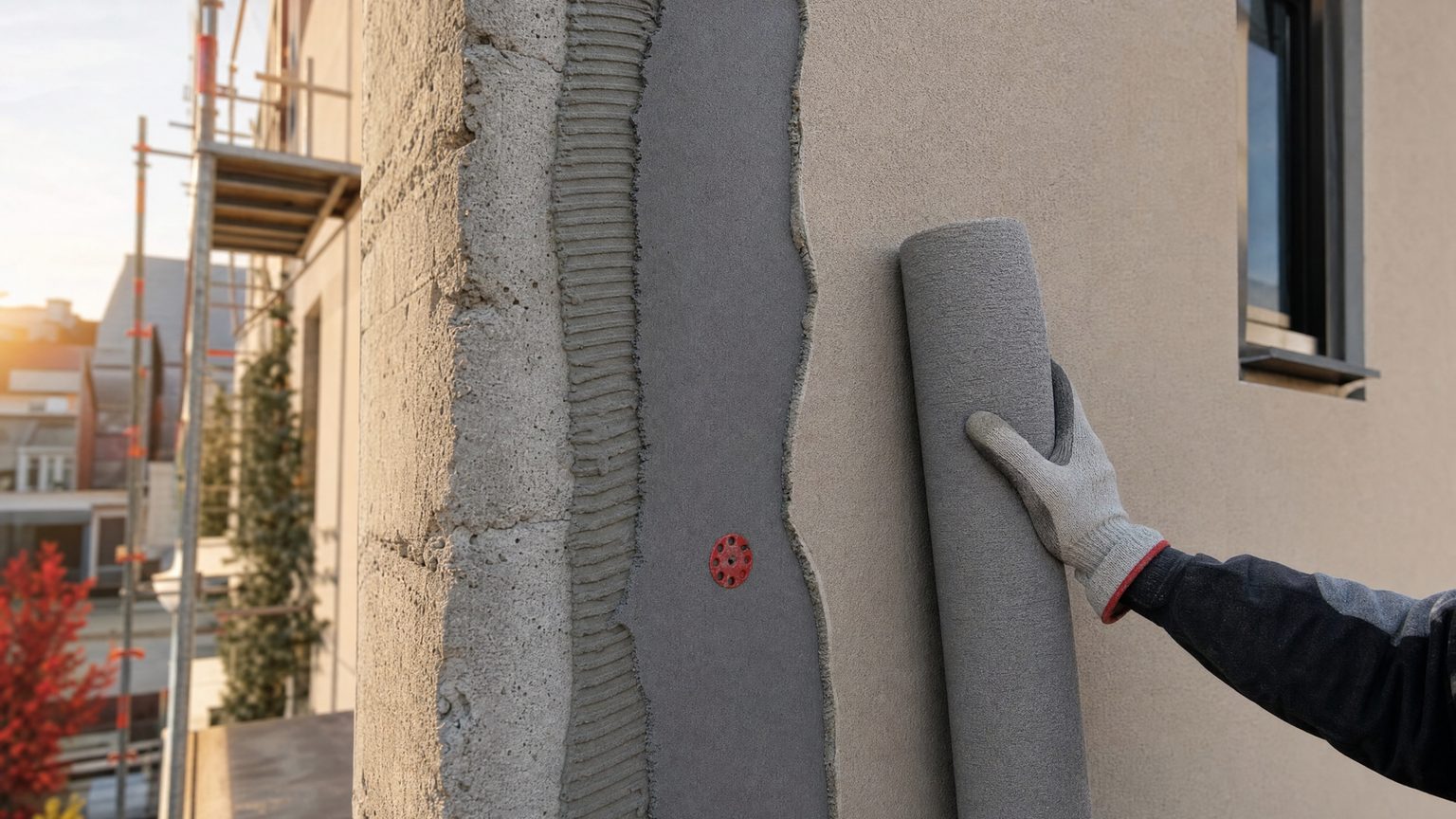
Every year, exterior insulation is applied to hundreds of thousands of buildings. But here is what we see in the field: a significant share of insulated buildings lose their original energy performance within a few years. The culprit is usually not the installer, but a material choice that looks great on paper yet doesn't hold up to real-world conditions. And the number-one cause of this loss is almost always the same: moisture created by temperature swings.
In this guide we look, with an impartial eye, at the criteria you should weigh when choosing an exterior insulation material, laying out the strengths and weaknesses of the main options on the market.
1. Is the λ Value Enough on Its Own? The Real Measure Is the Wall's Total U-Value
The core performance indicator of an insulation material is its thermal conductivity (λ). The lower the value, the less heat the material conducts. The typical λ ranges of common materials on the market are actually quite close to one another:
- EPS: 0.035 – 0.040 W/mK
- XPS: 0.030 – 0.038 W/mK
- Rock wool: 0.035 – 0.040 W/mK
- Composite insulation layer (PE foam + polyester fiber): 0.037 – 0.040 W/mK
As you can see, there is no vast gulf between the λ values. What really matters is the total U-value the material produces together with the wall composition. Recognised thermal-performance regulations define the maximum U-value your wall may reach for your climate zone; the calculation evaluates the wall material (aerated concrete, thermal-insulation brick, pumice, reinforced concrete…) and the insulation layer together.
The good news: when applied with modern insulating wall blocks (aerated concrete, thermal-insulation brick and the like), a 2 cm composite insulation layer meets the required U-value limit on many wall types. You don't have to guess for your own wall — our technical team can confirm the right build-up for your project.
Expert note: Always have the λ value in a sales brochure verified with an accredited laboratory report. Ask for a documented figure, not phrases like "super insulation".
2. Materials on the Market: Who Is Good at What?
Let's look at the main materials with their strengths and weaknesses:
EPS (Expanded Polystyrene): The most economical option on the market; widely applied, with plenty of experienced installers. On the other hand it has many weak points: low mechanical strength, dimensional change over time (shrinkage), sensitivity to UV and heat, the ability to absorb water at cut surfaces, and poor resistance to rodents and pests. Its fire behaviour is also weak (Class E; it must always be used with a fire barrier).
XPS (Extruded Polystyrene): Thanks to its closed-cell structure it resists water, and is often preferred for below-grade and foundation insulation. However, its vapour permeability is very low — in an incorrect layer sequence it can trap moisture inside the wall — and it is combustible (Class E), requiring protective layers for fire resistance.
Rock wool: The champion of fire safety — it is Class A1 non-combustible, and is required by regulation on tall buildings (above 28.5 m). Its critical weakness is water: its fibrous structure takes moisture into itself, and once wet, rock wool loses a large part of its insulation performance. It also requires protective equipment during application and produces high offcut waste.
The picture is clear: every material has a strong point — but all three face the same two tests, which we cover below: the separation interface, and behaviour over time against moisture.
3. Thermal Bridges and the Separation Interface: The Invisible Gap Between Wall and Board
When people think of thermal bridges, they picture column-beam junctions and window edges; these are solved with correct detailing. But there is another, less-discussed structural issue: the separation interface.
Rigid boards (EPS, XPS, rock wool board) are fixed to the wall with adhesive mortar and dowels. By the nature of this method, the board and the wall never make one-hundred-percent contact; micro-gaps, air pockets between mortar dabs and separations that develop over time remain in between. Why does this in-between zone matter?
In winter, water vapour moving from the interior toward the wall can reach its dew point at this cooler interface. The condensed water collects in that gap; the wall gets wet, the adhesive weakens, and mold stains appear on interior surfaces. "We had insulation done, but there is still mold in the corners" — the technical source of that complaint is very often exactly this.
That is why the critical question when choosing a material is: Does this material work integrated with the wall, or does an "interface" remain in between?
4. The Time Test Against Moisture: The First-Year λ — What Is It in Year Five?
The λ values in brochures are measured under dry, laboratory conditions. A façade, however, lives with rain, freeze-thaw cycles, indoor vapour and moisture rising from the ground. The material's real test is this: does it keep its insulation value when it meets moisture?
Physics is merciless here: water conducts heat about 25 times better than air. The λ value of an insulation material that takes on moisture rises quickly — meaning its insulating property melts away. Fibrous materials are the most fragile group in this respect; closed-cell foams are more resistant, but the interface problem described above persists with them too.
The conclusion: the true return on an insulation investment is shown not by the first year's bill, but by the bills of years five and ten. A material that is unaffected by moisture and works integrated with the wall keeps its original insulation value for years; those that are affected quietly lose performance.
5. Fire Safety: A Non-Negotiable Criterion
Fire-protection regulations set the material's fire class according to building height (EN 13501-1). Summary table:
- A1 (rock wool): Does not burn at all; required on tall buildings (above 28.5 m).
- E (EPS/XPS, flame-retardant): Combustible; must be used with fire barriers and protective layers.
- B-s1,d0: Hard to ignite, produces very little smoke, and forms no burning droplets. It is one of the strongest safety profiles achievable among polymer-based materials.
Pay special attention to smoke behaviour: in a fire, the main cause of loss of life is not flame but smoke. That is why the "s1" (very little smoke) and "d0" (no dripping) suffixes are as important as the class letter itself.
A New-Generation Approach: A Composite Insulation Layer That Integrates With the Wall
The industry produced a new-generation answer to the two structural problems above — the separation interface and performance loss against moisture: a composite insulation layer that works integrated with concrete and plaster.
This new-generation patented technology works on a different principle from classic rigid boards, thanks to its three-layer composite structure of polyester fiber and closed-cell polymer foam.
- Leaves no separation interface: It physically integrates with concrete and plaster; no gap forms between wall and insulation where condensation could settle. The structural weakness of rigid boards disappears here.
- Applied without thermal bridges: Its thin, flexible structure allows continuous application at column-beam junctions, window edges and corner details; the weak points that form at the joints of rigid boards do not occur here.
- Unaffected by moisture, keeps its value: Thanks to its high vapour-diffusion resistance (μ=584) it holds no moisture within, and keeps its 0.037 W/mK insulation value for years. The first-year performance and the tenth-year performance are the same.
- B-s1,d0 fire class: Hard to ignite, very little smoke, zero burning droplets.
- αw 0.30 sound absorption: Alongside thermal insulation, it also contributes to acoustic comfort.
- Same body on façade and interior: Unlike classic insulation systems, it is used both in exterior façade applications and in interior solutions; it can be applied at building scale or apartment by apartment.
At a 2 cm application thickness, it meets the required U-value limit on most common wall materials — our technical team can confirm the exact build-up for your wall.
Before You Decide: A 5-Question Checklist
Whatever material you choose, ask these five questions before ordering any insulation material:
- Does my wall composition's total U-value meet the required limit? (Don't just look at the λ label.)
- Does the material keep its insulation value when it meets moisture?
- Does it work integrated with the wall, or does it leave a separation interface?
- What is its fire class — and are its smoke/dripping behaviour (s, d suffixes) documented?
- How are the thermal-bridge details (window, sill, dowel) solved?
The right material determines the comfort, a healthy interior and the energy savings not only of today but of the next ten years. Base your decision on documented values rather than brochure promises; and if you want to be sure, you can consult our technical team.
Still planning your project?
The right insulation depends on your climate, your building and your budget. Our technical team can help you get it right from day one — before a single panel goes up.