48°C in the shade in Baghdad, a "feels-like" temperature reaching 55 in Dubai because of the humidity, desert winds blowing hot in Tripoli, and sea humidity that never lets up in Cyprus. Constructing a building in these climates is a completely different engineering problem from building in a temperate city. Yet in the field, most projects still proceed with an insulation logic designed as if the real concern were losing heat in winter.
In hot climates, however, the equation flips. In this article we walk step by step through why a building in a desert or coastal climate turns into an oven, which surfaces carry the real load, and what the right insulation changes — from the air-conditioning bill to everyday living comfort.
In Hot Climates, Heat Flows the Other Way: The Battle Is in Summer, Not Winter
Cold-climate insulation has a single goal: to stop the indoor warmth from escaping. Heat flows from inside to outside, and you slow that flow down.
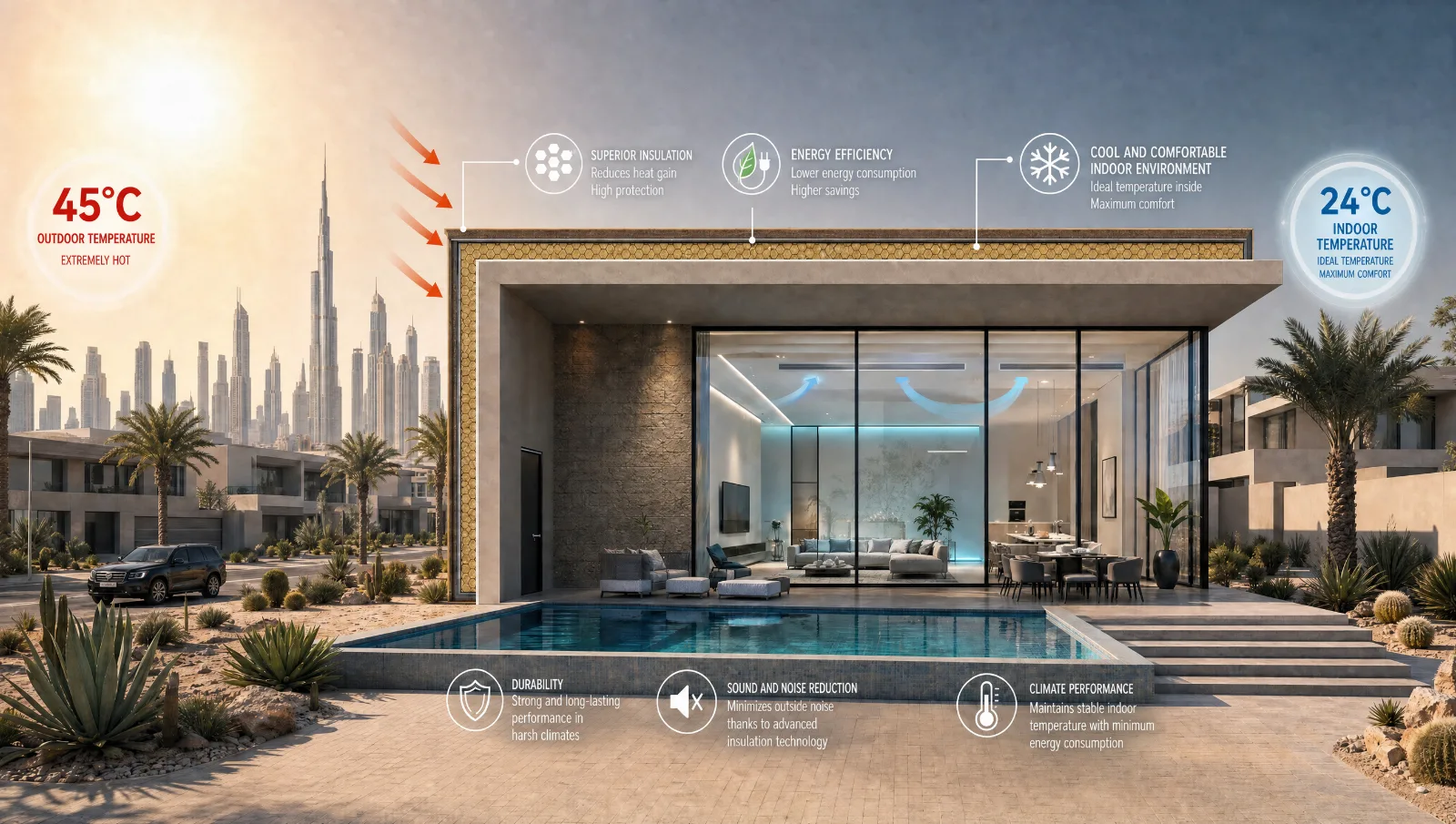
In a hot climate this picture turns upside down. Because it is far hotter outside than inside, heat flows from outside to inside all day long. The sun heats the roof and façade, that heat passes through the wall and fills the room, and the air conditioner constantly tries to push this unwanted heat back out. So in a hot climate, the job of insulation is not to keep heat in, but to keep heat out.
This distinction may sound small, but it changes everything. A building not designed for heat gain cannot cool down no matter how powerful an air conditioner you install, because the system is forced to run non-stop — as if trying to cool the heat pouring in through an open window. In a hot climate, the right insulation is not what makes the air conditioner's job easier, but what makes most of that job unnecessary in the first place.
Two Different Enemies: Desert (Iraq, Libya) vs. Humid Coast (UAE, Cyprus)
"Hot climate" is not one single thing. The same insulation decision may be right in Baghdad yet fall short on the Dubai coast, because you face two separate enemies.
Dry desert climate (Iraq, inland Libya): Here there are two big problems. The first is the huge temperature swing between day and night. Air that climbs to 48°C by day can fall to the low 20s at night. The building material stores heat all day and then radiates it inward at night; a building with high thermal mass but no insulation stays hot inside for hours after sunset. The second problem is dust: fine desert dust settles into ventilation gaps and onto the surface of porous materials, degrading performance over time. In the desert, insulation must both withstand temperature swings and stay stable against dust.
Humid coastal climate (UAE, the coasts of Cyprus): Here the real enemy is not temperature but humidity. High water vapour in the air, combined with a salt-carrying sea breeze, creates a harsh environment for insulation material. A material that absorbs moisture eventually gets wet; a wet material both loses its insulating power and sets the stage for mold and decay. In a coastal climate, what matters is not a material's day-one performance but the performance it holds for five years by repelling moisture.
In short, heat management and durability come first in the desert, while moisture resistance comes first on the coast. The good news: solutions that combine moisture, heat and durability in a single product can close both fronts at once, making them ideal for hot-climate regions.
The Surfaces the Sun Hits Hardest: Roof and Façade
Most of the heat entering a building in a hot climate comes from two places: the roof and the façade.
The roof, being the surface that faces the sun most directly, collects the most heat throughout the day. The surface temperature of an uninsulated flat concrete roof can exceed 70–80°C at midday. This heat drops straight down to the top floor below; that is why, in hot climates, top-floor apartments are almost always known as the "hottest apartment." Roof insulation is, without question, the number-one priority in a hot climate.
The façade heats up in turn with the sun's movement through the day: the east face in the morning, and the west and south faces bearing the heaviest load in the afternoon. Façade insulation manages not only heat but also the moisture seeping in through the façade; this dual duty is critical, especially in a coastal climate.
The core principle here is this: stopping heat before it enters the building is always cheaper and more effective than trying to cool it down after it gets in. That is why allocating the insulation budget first to the surfaces that get the most sun is the decision with the highest return.
The Hidden Weight of the Cooling Bill
In hot-climate regions, the bulk of a home's or office's electricity bill goes to one line item: cooling. In the Gulf, a very large share of a household's summer electricity is spent on air conditioning.
The point that gets overlooked is this: an air conditioner does not produce cold, it merely carries unwanted heat outside. The more heat a building lets in, the harder the AC works, the more electricity it burns, and the sooner it wears out. Insulation directly lowers the AC's load precisely because it reduces, at the source, the amount of heat coming in.
Think of it this way: a poorly insulated building is like a bucket with a hole in it. No matter how much cold air (that is, electricity) you pour in, heat keeps leaking through the hole. Insulation plugs that hole. The result is not just a lower bill; it means a cooling need that can be met with smaller capacity, longer-lasting equipment, and comfort that lasts a few hours indoors even when the AC breaks down. In a hot climate, insulation is not a cost item but an investment that pays for itself within a few years.
Condensation Works in Reverse in the Heat: Moisture From Outside In
When people hear "condensation," most think of a cold climate: while it is freezing outside, the warm humid air indoors sweats on the cold wall. In a hot, humid climate this process runs in the opposite direction.
If it is 40°C and highly humid outside, while indoors the air has been cooled and dried to 23°C by the AC, the moisture-laden hot outdoor air is now pushed toward the cold inner side of the wall. Somewhere inside the wall, when this hot humid air cools enough, the water vapour condenses and a hidden pocket of moisture begins to build up inside the wall. It is invisible from outside, but over time it wets the material, lowers its insulation value, and heralds mold.
That is why, in a coastal climate, not only a material's thermal resistance but also its behaviour against moisture is vital. A material that soaks up and holds water loses both its insulating power and its integrity within a few seasons. A closed-cell structure that repels moisture, by contrast, does not let condensation settle inside the material. When choosing insulation for hot, humid regions, the question should be as much "does it still stay dry after five years?" as "how well does it insulate?"
Expert note: The most common mistake in a hot climate is making the decision by looking only at the thermal conductivity (λ) value. A low λ measured in the lab quickly loses its meaning once the material gets damp in the field. In a humid climate, real performance is not the day-one λ but the value the material holds for years under moisture, dust and temperature swings. When choosing a material, look at the whole material, not a single number.
Sound Is a Comfort Issue Too
Construction in hot-climate regions is often dense and fast: growing cities, non-stop building sites, traffic, and outdoor AC units running day and night on nearly every building. All of this creates another problem as annoying as heat: noise.
The good news is that the insulation you install for heat can often work for sound too; but that depends on the material being designed for it. Structures that combine a porous layer absorbing sound waves with a dense layer stopping heat deliver thermal and acoustic comfort at the same time. Especially in projects such as hotels, hospitals, offices and multi-storey housing, this dual benefit justifies the investment on its own. In a hot climate, an interior that is cool and quiet is not just a technical achievement but a direct improvement in quality of life.
Heat, Sound and Moisture in One Layer: Why It Makes Sense for Hot Climates
So far we have spoken of three separate enemies: heat, moisture and noise. The traditional approach requires a separate material, a separate layer and a separate application step for each. Every extra layer means more labour on site, more time, and a greater risk of error between layers; and for a crew working at 45°C, every extra step is a real burden.
This is exactly where Three Flex's approach suits a hot climate. The single-layer composite structure — combining open-cell polyester fiber with a closed-cell EVA foam core — brings thermal insulation, sound absorption and a moisture barrier together in one product. A single layer means faster application on site, fewer connection points and less risk of error — a major advantage under conditions where labour efficiency matters in a hot climate.
The product family comes in three series for different needs: GOLD for the façade, PLUS for under screed and between floors, and EKO as an economical solution under carpet and laminate. This makes it possible to build holistic insulation from a building's roof to its floor using different versions of the same technology — one consistent answer to the hot climate's three enemies.
5 Questions Before You Start a Project
Before starting a project in a hot climate, test your material decision with these five questions:
- Does my roof take the main load of the sun? Is the roof first in your insulation budget, or was it an afterthought?
- Does my material still stay dry years later in a humid/salty environment? Did you look at its long-term behaviour, not just the day-one λ value?
- Is it suited to my region? Does it meet your needs for temperature swings and dust in the dry desert, and for moisture and salt resistance on the humid coast?
- Will it really lower my cooling load? Did you calculate the insulation's payback period against the cooling bill?
- How many problems does one solution close? Are you going separately for heat, sound and moisture, or with a single integrated layer?
If you can't answer these questions clearly, it is worth consulting an expert before you decide.
The Secret to a Cool Building Is Not in the AC, but in the Wall
In a hot climate, comfort is determined not by the air conditioner but by the building itself. A shell that stops heat before it enters, keeps moisture out and blocks noise solves most of the problem before leaving anything to the AC. The right insulation means lower bills, longer-lasting equipment, and interiors that are liveable in every season.
Whether your project is in Iraq, the UAE, Libya, Cyprus or another hot-climate region, bringing the right layer to the right surface takes expertise.
Still planning your project?
The right insulation depends on your climate, your building and your budget. Our technical team can help you get it right from day one — before a single panel goes up.